
The renko charts outwardly resemble three-linear breakthrough charts, but in case of the renko all boxes are of the same size. During drawing the indicator, only those movements which value is more or equal to a set threshold are considered.
Note:- Android and iOS powered devices offer us many features we do not even know about. One of these features is push notifications allowing us to receive personal messages, regardless of our phone number or mobile network operator. MetaTrader mobile terminal already can receive such messages right from your trading robot. You should only know MetaQuotes ID of your device. More than 9 000 000 mobile.
- It’s plain to see that electric vehicles are the future, but there’s more to making that change happen than swapping out a gas motor for a battery-powered one — especially in aircraft.
However, the benefits of installation are:
- Makes ExifTool available to all users.
- Saves typing on the command line (by placing 'exiftool' in your PATH).
- Installs the ExifTool documentation and API libraries (full Perl version only).
See the appropriate section below with instructions for installing oruninstalling ExifTool on your specific platform:
Also see these instructions for help runningExifTool.
Windows
In Windows, there is a choice of two different versions of ExifTool toinstall. The Perl distribution requires Perl to be installed on your system.(A good, free Perl interpreter can be downloaded fromactiveperl.com.)
If you don't already have Perl, it is easier to install the stand-alone ExifToolexecutable, but note that the stand-alone version doesn't include the HTMLdocumentation or some other files of the full distribution.
Stand-Alone Executable
- Download the Windows Executable from the ExifTool home page.
(The file you download should be named 'exiftool-12.22.zip'.) - Extract '
exiftool(-k).exe' from the'.zip' file, and place it on your Desktop.
(Double-click on 'exiftool-12.22.zip' to openthe archive, then drag 'exiftool(-k).exe' to your Desktop.)
You can now double-click on 'exiftool(-k).exe' to read theapplication documentation, or drag-and-drop files and folders to run exiftool onselected files. To install exiftool for use from the command line,continue with the following steps:
- Rename '
exiftool(-k).exe' to 'exiftool.exe'.
(or 'exiftool(-k)' to 'exiftool' if file nameextensions are hidden on your system) - Move '
exiftool.exe' to the 'C:WINDOWS' directory(or any other directory in your PATH).
You can now run exiftool by typing 'exiftool' at the commandprompt. (To get to the command prompt, select 'Run...' from the Windows 'Start'menu, then type 'cmd' and press Return.)
Notes:
- In Windows 7, running exiftool may require administrator privileges. Ifnecessary, this may be enabled by right clicking on exiftool, then selecting'Run this program as administrator' from the Compatibility settings.
- Windows 10 users have sometimes reported that exiftool hangs when run.This may be due to Windows Defender blocking or slowing down exiftool. To solvethis, either disable Windows Defender or add an exclusion for exiftool (but notethat exiftool may still run more slowly if you just add an exclusion).
- Occasionally users have reported that exiftool gives errors when runningthis version for this first time. It is possible this may happen if theinstallation process gets interrupted. In this case, follow the Uninstallinginstructions below then re-install exiftool. Be sure that you have sufficientdisk space in your TEMP directory for exiftool to unpack about 12 MB oftemporary files -- these are the Perl libraries used by the exiftool applicationwhich are unpacked the first time exiftool is run.
- Drag '
exiftool(-k).exe' (or 'C:WINDOWSexiftool.exe')into the Recycle bin. - Drag the directory '
par-XXX' from your temporary directory tothe Recycle bin. Here 'XXX' is your user name (in ASCII-hex forExifTool 10.21 or later) and the location of the temporary directory depends onthe value of the TEMP environment variable (typically'C:Documents and SettingsUSERLocal SettingsTemp'for Windows XP, or 'C:UsersUSERAppDataLocalTemp' for Windows 7or later). Alternately, this command may be used to delete these files:for /D %d in (%TEMP%par-*) do rmdir /s /q %d
Full Perl Distribution
You must have Perl installed to use this version. (A free version of Perlcan be downloaded fromactiveperl.com.)
- Download the Image-ExifTool distribution from the ExifTool home page
(The file you download should be named 'Image-ExifTool-12.22.tar.gz'.) - Extract the ExifTool files from the archive.
(The archive is a gzipped tar file, and can be opened withvarious Windows utilities, including WinZip.) - Rename '
exiftool' to 'exiftool.pl'in the exiftool distribution. - Move '
exiftool.pl' and the 'lib'directory from the exiftool distribution to 'C:WINDOWS'(or any other directory in your PATH).
Now, if you have made the proper Windows associations for the'.pl' extension (an option in the ActivePerl installation), youcan run exiftool by typing 'exiftool.pl' at the'cmd.exe' prompt. Otherwise you should type'perl c:windowsexiftool.pl'.
- Drag '
C:WINDOWSexiftool.pl' and'C:WINDOWSlib' into the Recycle bin. You should first confirmthat 'C:WINDOWSlib' contains only the 'File'and 'Image' sub-directories. Do not delete it if itcontains anything else.
If you have installed the BSDSDK package from the Xcode Developer Tools(ie. if you have the 'make' utility), you shouldfollow the install procedure for Unix platforms in the nextsection instead of the steps below. The Unix install has the advantage of makingthe ExifTool library available for your Perl scripts, as well as installing theman pages and POD documentation.
Otherwise, you have a choice of two packages to install: The MacOS package, orthe full Perl distribution. Both of the procedures below install the ExifToolfiles in the same location. Installing from the MacOS package is easier, but thefull distribution includes HTML documentation and some other files not includedin the MacOS package. Both versions run natively on PPC and Intel Macs.
MacOS Package
- Download the ExifTool MacOS Package from the ExifTool home page.
(The file you download should be named 'ExifTool-12.22.dmg'.) - Install as a normal MacOS package.
(Open the disk image, double-click on the install package, and follow the instructions.See the second item in the Notes section below if you are stopped with an 'unidentified developer' message.)
You can now run exiftool by typing 'exiftool' in a Terminal window.
If this doesn't work, then it is likely you have an older version of MacOS for which/usr/local/bin isn't in the default PATH. To fix this, add the following line to your~/.profile settings using a text editor:
export PATH=$PATH:/usr/local/binFull Perl Distribution
- Download the Image-ExifTool distribution from the ExifTool home pageto your Desktop.
(The file you download should be named 'Image-ExifTool-12.22.tar.gz'.) - Launch the Terminal application from the Utilities folder in your Applications folder.
- In the Terminal window, type the following:(Note: The last step above will require you to enter yourpassword.)
You can now run exiftool by typing 'exiftool' in a Terminal window.
Notes:
- Both MacOS installation techniques outlined above placeexiftool and its lib directory in /usr/local/bin, while the standard Unix'
make install' described below puts 'exiftool' in/usr/local/bin and the individual libraries in /Library/Perl/#.#.#, where '#.#.#' isyour Perl version. If both sets of libraries exist, /usr/local/bin/lib takesprecedence for exiftool, but /Library/Perl/#.#.# is the default for any otherPerl scripts. - In MacOS 10.8 or later, you may see this message when you try to open the install package:
'ExifTool-12.22.pkg' can't be opened because it is from anunidentified developer.
The solution is to control-click on the pkgthen select 'Open' from the pop-up menu instead of just double-clicking. An alternativeis to lower the security settings by changing 'Allow applications downloaded from' to'Anywhere' in the General 'Security & Privacy' System Preferences.(Read here orherefor a full description.)
Uninstalling
- Launch the 'Terminal' application from the Applications Utilities folder.
- Type '
open /usr/local/bin' (without the quotes) in the Terminalwindow, then press RETURN. (This opens a folder that you normally can't accessfrom MacOS.) - Drag '
exiftool' and 'lib' into the trash from the'bin' folder you opened. You should first confirm that'lib' contains only two sub-folders: 'File' and'Image'. If it contains anything else, don't trash it because youhave the wrong 'lib' folder.
Unix Platforms
- Download the Image-ExifTool distribution from the ExifTool home page
(The file you download should be named 'Image-ExifTool-12.22.tar.gz'.) - Unpack the distribution and make it your current directory by typing:(At this point you may run exiftool by typing'
./exiftool <image file name>'.) - Test and install ExifTool by typing:(Note: The '
make test' step is not required, butuseful because it runs a full suite of tests to verify that ExifTool is workingproperly on your system. The 'sudo make install' command requiresthat you have su access, and will prompt for your password. This will makeExifTool and its documentation accessible to all users on your system. If youdon't have su access, you can run ExifTool in your own account by moving'exiftool' and its 'lib' directory to any convenientlocation, preferably somewhere in your PATH.)
You can now run exiftool by typing 'exiftool'. Also, you canconsult the ExifTool documentation with commands like:
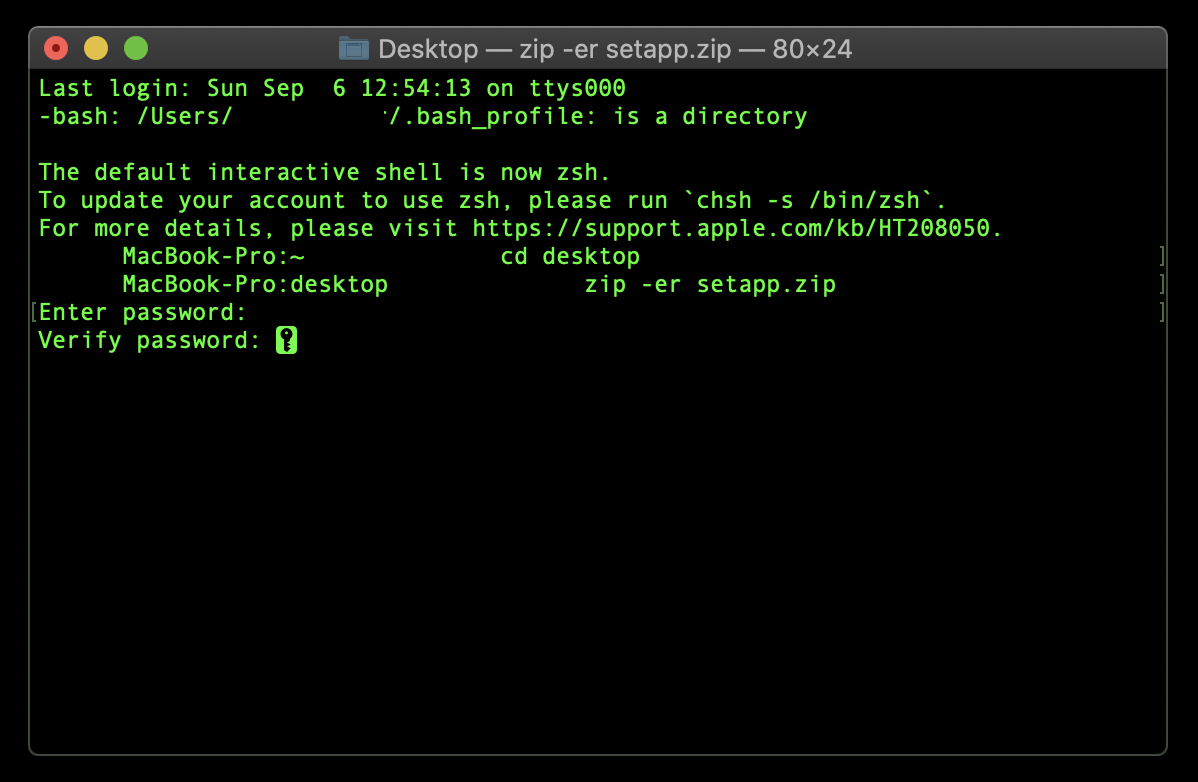
Mac Terminal Create Zip With Password
or
Uninstalling
- Type '
sudo make uninstall' from the distribution directory.
(Note: Unfortunately, newer systems may give an 'Uninstallis unsafe and deprecated' message even though uninstalling ExifTool is safebecause it has no dependencies. If this happens, the necessary commands toremove the installed files will be listed, and these commands must be runmanually.)
Mac Zip With Password Terminals
To completely remove all Norton application files and references on your Mac, download and run the RemoveNortonMacFiles tool.
Download and run RemoveNortonMacFiles as an administrator
Download the RemoveNortonMacFiles.zip file.
Click the Finder icon in the Dock.
In the Finder window, click Downloads in the left pane under Favorites.
Do one of the following:
If you downloaded the file using Safari browser, open the RemoveNortonMacFiles folder.
If you downloaded the file using the Mozilla Firefox or Google Chrome browsers, double-click the RemoveNortonMacFiles.zip file to expand it, and then open the RemoveNortonMacFiles folder.
In the RemoveNortonMacFiles folder, control-click the RemoveNortonMacFiles.command file, and then click Open with > Terminal (default).
To run this tool, you must be logged on with an Administrator account and a non-blank password.
Do one of the following:
If you have not uninstalled Norton application on your macOS 10.15.x or later, a message appears in the Terminal window that prompts to drag and drop Norton from Applications folder to Trash. Go to step 7.
If you have macOS 10.14.x and earlier, OR if you already uninstalled Norton on your macOS 10.15.x or later, go to step 13.
In the Terminal window, press return to open the Applications folder in Finder.
In the Applications folder, select the Norton application, and then drag and drop it to the Trash.
When you see a prompt, type your administrator account password, and then click OK.
In the Norton installer window, click Uninstall.
If you see a prompt, type your administrator account password, and then click Install Helper.
When the Norton uninstall finishes, run the RemoveNortonMacFiles.command file in Terminal again.
For more information, refer to the instructions in step 5 above.
In the Terminal window, type your administrator password, and then press return.
When you type your password, no characters appear.
To remove all Norton files and folders, type 1.
If you want to quit RemoveNortonMacFiles without removing any files, type 2.
Press return.
RemoveNortonMacFiles tool removes all of the Norton files.
When the RemoveNortonMacFiles tool finishes removing the Norton files, in the Terminal window, type y, and press return to restart your Mac.
Before you press return, make sure that you save your work in other open applications.
RemoveNortonMacFiles removes all the folders that Norton installers created, and all the files within those folders including any that you have created.